Jul 16, 2026
Pin, magnet or lanyard: mounting hardware decides whether a badge survives the bag
A badge spends its life clipped to a bag full of keys. What fails first is rarely the electronics — it is the mount. Here is how the three options compare.
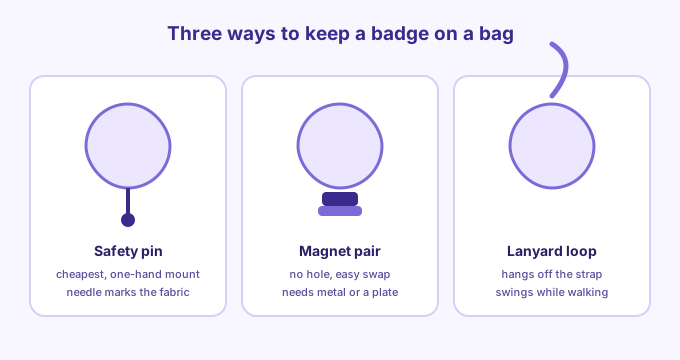
Badges are not worn on a jacket lapel anymore; they live on bags. That single change moves the mechanical problem from decoration to structure: a bag gets dropped, swung, stuffed into a locker, and shares space with keys and a metal clasp. The mount is where most returns begin.
Safety pin: cheap and familiar, with one flaw
The classic pin is the cheapest mount, needs no counterpart on the bag, and is understood instantly by the buyer. Its flaw is fabric damage: a needle point works through the weave, and a badge that weighs 30 grams with electronics pulls harder than a printed one. Reinforcing the pin boss — a small steel plate inside the shell — is the difference between a season and a month.
Magnet pair: the modern default
A magnet pair needs no hole, allows instant repositioning, and gives a clean back. The trade-off is that it only works on fabric thin enough for the field, or with a steel plate sewn into the bag lining. We size the magnet for a 30–40 gram badge with a 1.5 mm gap, and always specify the plate, because a badge that slides down a strap at a convention is the fastest way to lose a customer.
Lanyard loop: the display option
A loop keeps the badge facing out and lets it swing free — which is exactly what some buyers want and exactly what others hate. If a loop is offered, the anchor has to be a moulded boss rather than a glued ring, and the loop material has to survive friction against a strap for months.
Choosing by use case
Conventions and photo-heavy use: loop or magnet. Daily bag wear with a thick bag: pin with a reinforced boss. Multiple badges swapped often: magnet plus plate. We ask clients one question — how many badges will one buyer carry at once — because two magnet badges on the same strap need spacing, and that changes the shell design.