Jun 22, 2026
The thickness budget: how thin an electronic badge can actually be
A badge stops reading as merch at a specific millimetre. Here is where the 8–11 mm of a working electronic badge actually goes, and what each millimetre buys.
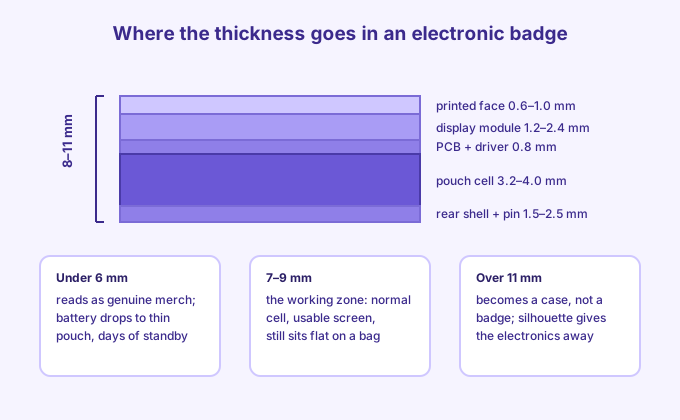
Printed acrylic badges are 3–4 mm thick and cost almost nothing. Add a screen, a battery and a radio and the object changes category: at 11 mm it is a small case, at 7 mm it is still a badge. The whole design conversation is about which millimetres you are willing to spend.
The stack, measured from the front
A working badge is roughly: printed face 0.6–1.0 mm, display module 1.2–2.4 mm, PCB and driver 0.8 mm, cell 3.2–4.0 mm, rear shell and mounting hardware 1.5–2.5 mm. Add tolerances and adhesive and you land between 8 and 11 mm for a colour display with a normal pouch cell.
What each millimetre buys
Going below 6 mm is achievable, but not with the same battery: capacity falls to a few days of standby and the screen has to give up either size or brightness. Between 7 and 9 mm you keep a real cell and a readable display while the badge still sits flat against a bag. Past 11 mm the silhouette reads as electronics first and merch second — which is fine for a wearable device and wrong for a badge.
Where teams overspend
Two places. First, choosing a display with a thick backlight assembly to get one more nit of brightness; the badge is viewed at arm’s length indoors. Second, keeping a USB-C connector on the edge with a full-height port and a sealed door — the port alone can cost 2 mm of local thickness. A pogo-pin charging contact or a magnetic charge pad trades convenience for a much thinner edge.
The prototype test we run
Print the badge at true thickness in PLA before any tooling, clip it to a bag, and wear it for a day. People stop noticing electronics and start noticing weight and swing — and that judgement arrives earlier than any spec sheet can deliver it.